
You have no items in your shopping cart.
LED Power Supply Temperature Derating in Signage Enclosures
Thursday, October 22, 2026
Click here to download PDF
A 180W rating does not necessarily mean 180W is available at every permitted temperature. For a power supply inside an illuminated sign, check the air temperature around the unit against the exact model’s ambient-temperature loading curve. The weather forecast alone cannot establish the available output.
In this guide
Which temperature matters inside a sign?
Ambient temperature refers to the surrounding environment at the power supply. It is different from the temperature of the metal housing and from a weather reading taken elsewhere. A sign enclosure can contain several heat sources, and the conditions around its power supply may differ from the outside air.
For selection, ask the installer or system designer to establish the expected local ambient temperature under the intended operating conditions. A short check with the sign open does not establish the temperature after the completed enclosure has been operating. Equally, a hot housing cannot be compared directly with a graph labelled “ambient temperature.” If the measurement location or method is unclear, request the manufacturer’s guidance.
Read the exact model’s loading curve
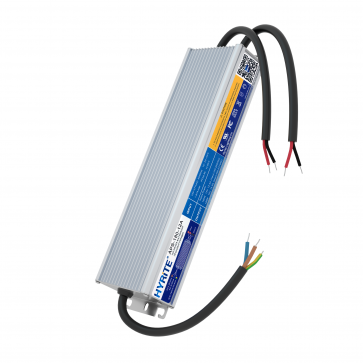
The standard HYRiTE APS-180-12A is specified at 12V DC, 15A and 180W. In its 2024.07.01 specification, the operating-temperature entry is -25°C to +60°C and explicitly refers to the loading-versus-ambient-temperature graph. That range must therefore be read together with the graph.
The plotted load is 100% at 40°C and falls to 80% at 60°C. At the upper endpoint, the temperature-curve calculation is 180W × 80% = 144W, or 12A at nominal 12V. This explains why “operates up to 60°C” should not be read as “delivers 180W at 60°C.”
| Local ambient | Load shown on the curve | Temperature-only output ceiling |
|---|---|---|
| 40°C | 100% | 180W; 15A at nominal 12V |
| 60°C | 80% | 144W; 12A at nominal 12V |
Source: APS-180-12A specification, page 1. These values apply to this model and document version. Confirm the specification for the exact version being ordered.
Would a proposed 150W LED load pass?
Consider a hypothetical sign with a total 150W load on this standard 12V supply. Assume a 230V AC input for this example, which is in the full-load region of the separate input-voltage curve. Include any controller powered by the same unit when calculating the total.
At 40°C local ambient, 150W is below the temperature-only ceiling of 180W. At 60°C, the same load exceeds the 144W ceiling by 6W. Expressed as current, 150W ÷ 12V = 12.5A, which exceeds the temperature-curve value of 12A. A load below the nameplate rating can therefore still fail the operating-condition check.
This is a selection example, not a tested customer installation or a recommended operating margin. Passing one curve does not establish final suitability. Check input voltage, temperature, output configuration and all installation requirements together; request a model-specific assessment when their combined effect is unclear.
Review the enclosure as part of the selection
The same specification calls for sufficient ventilation and says not to install the power supply in a completely sealed location or close to flammable or explosive objects. Review that requirement before accepting a sign enclosure design. The unit’s IP rating does not cancel its cooling and installation instructions.
If the proposed location does not meet those conditions, ask the system designer and supplier to review the arrangement. Do not assume a larger headline wattage, a different mounting position or an added fan automatically resolves the issue. Any revised selection needs its own applicable specification and assessment.
Prepare a useful technical enquiry
Provide the exact supply model and version, LED and controller load, expected AC input range, expected local ambient temperature, enclosure construction, mounting arrangement and available ventilation. Include the basis for the temperature estimate or measurement. These details allow the supplier to identify which conditions need further checking before a quotation is finalized.
Start with the APS-A 180W product and matching datasheets. Read the input-voltage derating example for the separate mains-supply check, or use our signage enquiry checklist to organize project information. Browse the power supply range and contact HYRiTE for a review of your proposed conditions.
← Back to Blog & Insights<< back