
You have no items in your shopping cart.
Can a 180W LED Power Supply Deliver 180W at 110V? Reading the Input Derating Curve
Tuesday, October 20, 2026
Click here to download PDF
An input label tells you which AC supply a power supply can accept. It does not necessarily promise full rated output across that entire range. For a signage project, those are two separate checks: whether the unit can operate from the available supply, and whether it can deliver the proposed LED load under those conditions.
That distinction matters when a product is quoted for a 110V or 120V installation using only its headline wattage. Before ordering, match the actual input conditions to the loading curve for the exact model and version. A higher number on the product name is not a substitute for this check.
In this guide
Start with the exact model and the site supply
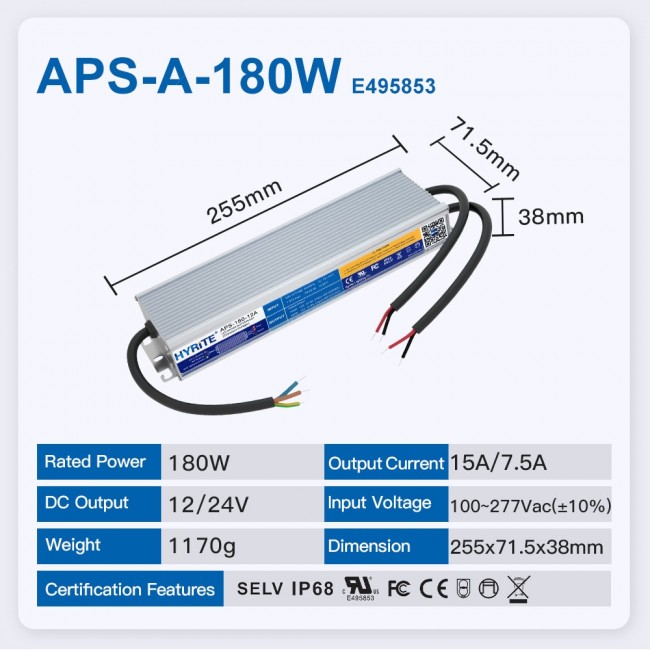
Consider the standard HYRiTE APS-180-12A, documented at 12V DC, 15A and 180W. Its specification includes an input-voltage loading curve. The nominal output rating provides the starting point for a calculation; the curve defines how much of that rating is available at particular input voltages.
Request the actual AC supply information from the installer, including the expected range rather than only the destination country. The power supply’s input voltage is the voltage at its AC terminals. The separate DC output-voltage check still needs to match the LED modules. An input derating curve does not turn a 12V output model into a 24V model.
Read the input curve before assigning the load
In the APS-180-12A specification dated 2024.07.01, the input curve shows a 75% loading region between 90V and 180V AC, rising to 100% at 200V. Read those points together with the stated input range and all other operating restrictions. A graph endpoint should not be used as permission to operate outside the specified range.
For a proposed 110V input within the documented region, 75% of 180W is 135W. At nominal 12V DC, that corresponds to 11.25A. The same input-curve region covers a proposed 120V input. These are calculations from this particular curve, not a universal rule for 180W power supplies.
| Proposed condition | Calculation | Preliminary input-curve result |
|---|---|---|
| 110V AC, 130W LED load | 180W × 75% = 135W | Below the input-only ceiling; other limits still apply |
| 110V AC, 150W LED load | 150W exceeds 135W | Does not pass the input-voltage check |
| 220V AC, 150W LED load | Curve permits up to the rated 180W from the input-voltage perspective | Further operating and installation checks required |
These load figures are hypothetical selection examples. They are not measurements of a customer installation, and passing the first row does not establish final suitability.
Check temperature and installation conditions separately
The input-voltage curve is only one part of the specification. Check the ambient-temperature loading curve, installation instructions, ventilation and any stated continuous-loading recommendation as well. A configuration must satisfy all applicable limits.
Do not automatically multiply two percentage figures or distribute a reduced total across separate outputs without instructions supporting that method. If simultaneous input and temperature conditions are unclear, send the manufacturer those conditions and request a model-specific assessment. For an optional multi-output version, the rating of every output also needs confirmation.
Likewise, avoid treating a fixed loading margin as a replacement for reading the curves. A proposed load can be below the nameplate wattage and still exceed the limit imposed by a particular operating condition.
Put the evidence into the quotation request
Provide the exact LED model and quantity, calculated load, expected AC input range, temperature at the power supply, and proposed mounting arrangement. Include controllers or other equipment drawing power from the same unit. Ask the supplier to identify the exact power supply version and the current specification supporting the quotation.
If a preliminary choice does not pass the curve, evaluate another suitable model or a revised supply arrangement with the supplier. Do not assume that changing only the headline wattage resolves all requirements. The replacement still needs the correct output, operating limits and installation documentation.
Review the APS-A 180W product page alongside its matching specification. Our signage enquiry checklist helps collect project details, while the multi-output guide explains per-output limits. Browse the product hub or send a project enquiry for help reviewing a particular supply condition.
<< back