
You have no items in your shopping cart.
Parallel LED Power Supplies for Signage: A HYRiTE TLG Application Guide
Saturday, November 14, 2026
Click here to download PDF
Large LED signs and lightboxes often need more power than a single compact power supply can provide. Parallel-capable supplies allow multiple units to serve a common LED load, with options for combined capacity and additional capacity reserve.
What does parallel output operation mean?
In a supported parallel arrangement, the positive DC outputs connect to a common positive distribution line, and the negative outputs connect to a common negative line. The compatible power supplies work together to serve the connected LED load.
The output voltage remains the selected system voltage. Parallel operation combines available output capacity; it does not add the output voltages together. Do not connect a 12V output and a 24V output to the same DC bus.
This differs from installing several power supplies with completely separate LED loads. It also requires models specifically approved for parallel operation. Matching voltage labels alone are not sufficient evidence of compatibility.
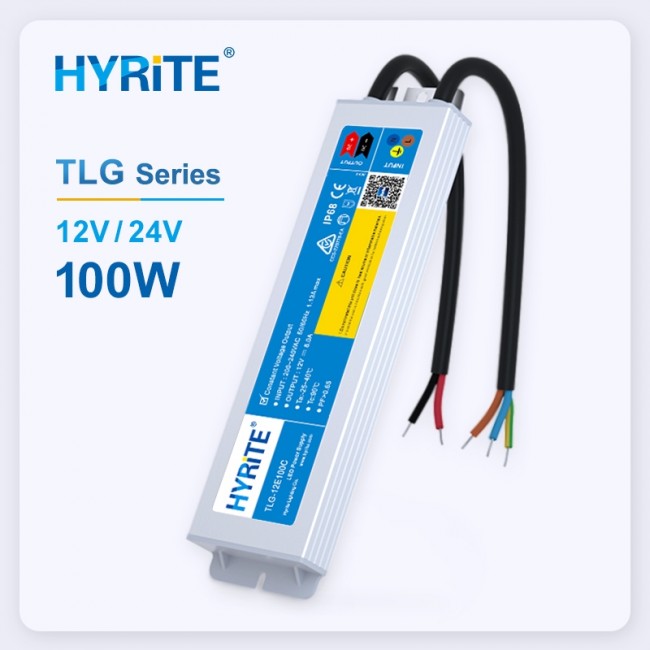
Model scope: HYRiTE TLG, LNS and HPS models rated 100W and above support parallel operation. Models rated 60W and below are outside this scope. Confirm the complete model references and approved combination before connecting the outputs; do not assume cross-series compatibility.
TLG example: two 300W units serving a shared load
HYRiTE's TLG application illustration shows two 300W power supplies connected to a common DC distribution system serving six 100W LED load groups. The example demonstrates a nominal 600W combined-capacity arrangement.
| Item | Illustrated configuration |
|---|---|
| Power supplies | Two parallel-capable 300W TLG units |
| DC distribution | Common positive and negative lines |
| LED load groups | Six groups of 100W |
| Nominal combined capacity | 600W |
This is a capacity illustration, not a universal recommendation to operate every installation at its combined nameplate rating. The actual design must account for the permitted output at the installation temperature and input voltage, together with wiring losses and the project's operating requirements.
The arrangement gives sign designers another way to distribute power supplies within an installation instead of assigning every unit to an isolated group of LEDs. Cable routing, access for servicing and the voltage delivered to the LED loads still require attention.
Adding capacity for an N+1 arrangement
An N+1 design adds one power supply beyond the number required to support the intended load. The TLG illustration adds a third 300W unit to a nominal 600W lighting system. If one unit stops contributing and the remaining two can each provide their required output, the remaining nominal capacity is still 600W.
That extra unit provides capacity reserve. It does not turn the installation into a 900W load design with the same one-unit-loss allowance.
Continued operation also depends on how the failure affects the shared output and on the installation's protection arrangements. The N+1 illustration is a planning concept, not a promise of uninterrupted lighting under every possible fault.
Continued lighting at reduced brightness is a different feature
HYRiTE's TLG material also describes an overload response that reduces output rather than repeatedly switching the lighting off and on. Its illustration shows two 100W units supplying a 200W LED load. When one unit is switched off, the remaining supply operates with reduced output, and the sign remains illuminated at lower brightness.
This differs from an N+1 system that retains sufficient capacity for the full intended load. Reduced-brightness operation can help preserve the visibility of a sign, but it does not mean that one 100W unit delivers 200W or that the original brightness is maintained.
The actual lighting response must be checked with the selected LED load. Protection behaviour is not a substitute for correcting an overload or replacing a failed unit.
Applying the concept to TLG, LNS and HPS projects
Start with a confirmed parallel-capable model in the appropriate range. Establish the required output voltage, normal LED load and the desired result if one supply becomes unavailable. Keep combined capacity for normal operation separate from reserve capacity for operation with a unit unavailable.
Do not assume that different series or versions can be mixed simply because each supports parallel operation. Obtain confirmation for the proposed combination and use the appropriate wiring and protection instructions.
Provide HYRiTE with the model references, LED voltage, total load, installation temperature and proposed layout. Explain whether the priority is flexible distribution, maintaining full lighting with a unit unavailable, or understanding reduced-brightness behaviour.
Explore the HYRiTE product range and TLG 300W power supply. Read the temperature derating guide, or contact our team to review your parallel application.
<< back